


Busway Transition Section
Working Principle
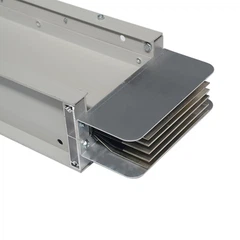
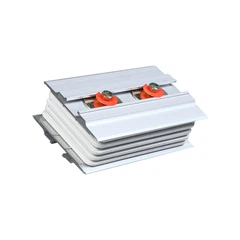
Bus duct size transition joint is a special transitional connecting fitting for busbar power distribution systems. It is mainly used to realize smooth connection between bus ducts with different rated currents and cross-sectional specifications, solving the industry-wide problem that high-current main bus ducts cannot be directly connected with low-current branch bus ducts. Suitable for engineering layouts with multiple loads and graded power distribution, it ensures standardized connection and stable operation of the entire power distribution system.
Its working principle relies on a gradient variable cross-section conductive transition structure to achieve stable current shunting and adaptive transmission. Two conductor cross-section specifications are adopted inside the transition joint: one end matches the conductor size of the high-current main bus duct to carry high-power transmission current on the high-voltage side, while the other end conforms to the current-carrying standard of the low-current branch bus duct at the rear section. By precisely optimizing the current density of conductors, it avoids current disorder, local heat accumulation, excessive joint temperature rise and other faults caused by abrupt cross-section changes, thus realizing uniform and stable transition transmission of electric current.
The product adopts an integrated enclosed housing and high-strength insulating support structure, which maintains continuous sealing protection and retains the original IP protection grade of the bus duct to prevent dust and moisture ingress. Meanwhile, it can offset dimensional deviations during installation and buffer slight vibration generated by equipment operation. Without compromising the safety of the power distribution system, it accurately meets the demands of graded power distribution and eliminates potential safety hazards brought by rigid connection between high-current and low-current bus ducts. It optimizes the power distribution framework, cuts equipment energy consumption and maintenance costs, and complies with construction standards for graded power distribution in various large factories, energy storage stations and computing power centers.
Product Advantages
Compared with traditional current conversion solutions such as cable bridging, terminal connection and full-line laying of uniform-specification bus ducts, the bus duct size transition joint delivers remarkable comprehensive advantages in graded conversion scenarios of high-current power distribution. It effectively addresses the pain points of conventional conversion methods, including excessive heat generation, messy wiring, high overall costs and poor safety performance, making it ideal for graded power distribution in energy storage power stations, computing power centers and large industrial plants. Traditional current conversion mostly relies on cable shunting and manually crimped terminal connections, which tend to cause uneven contact, local overload and excessive temperature rise, alongside cumbersome wiring and complicated post-operation maintenance.
Manufactured with a factory prefabricated integrated gradient variable cross-section structure, the transition joint enables smooth power transfer from high-current main bus ducts to low-current branch bus ducts with evenly controllable current density, eliminating heat accumulation and power loss induced by abrupt current changes. Its electrical stability far outperforms on-site manual terminal connections. In contrast to the redundant design of laying full-length large-size bus ducts, this transition joint switches current ratings according to actual demand to precisely match the power of downstream loads, greatly cutting material expenses and circuit energy consumption with outstanding economic benefits.
Furthermore, the joint retains the fully sealed protective structure of bus ducts, featuring reliable dust-proof, moisture-proof and insulating performance, which avoids hidden dangers like dust accumulation and aging leakage caused by exposed cable connections. Its modular docking design facilitates simple installation without complicated wiring procedures, shortening construction periods and lowering failure rates. Boasting a robust and durable overall structure capable of stable long-term full-load operation, it integrates multiple merits including safety, energy efficiency, low cost and easy maintenance, serving as the optimal solution for graded current conversion in high-end high-power power distribution projects.
Customization Capacity
The bus duct size transition joint supports all-round non-standard customization, with current rating conversion as its core customized module. Meanwhile, it can meet multi-dimensional engineering requirements involving housing, structure, installation and protection, flexibly adapting to various graded power distribution projects. Its current conversion range covers the full series of bus duct specifications from 500A to 6300A, enabling bidirectional smooth transition between high-current main lines and low-current branch lines, as well as standard-current busways and extra-large-current busways. A single transition joint is compatible with dozens of current matching combinations; conversion is unnecessary only for bus ducts with identical current ratings, fully fitting the graded power distribution layouts of energy storage power stations, computing power centers and industrial parks.
Beyond customized current ratings, the product supports dimensional customization. Its overall length can be adjusted in accordance with machine room floor height, pipeline shaft spacing and wall penetration positions. The housing can adopt lightweight aluminum-magnesium alloy profiles, and the matte plastic-sprayed surface finish can be customized as required. Two protection grades, IP54 and IP65, are available for selection to satisfy application scenarios including indoor power distribution rooms and outdoor new energy projects. The internal insulating components are made of Class B high-temperature resistant material by default, and fire-resistant insulating assemblies can be upgraded upon customers' flame retardant requirements.
Customization is also available for installation structures. Flange interfaces suitable for horizontal and vertical wiring can be configured, alongside optional shockproof supports and sealed wall penetration assemblies. A thermal expansion compensation structure can be integrated on demand to realize both current conversion and thermal expansion & contraction compensation functions simultaneously. All customized components are integrally prefabricated in the factory without on-site modification, ensuring excellent electrical stability and convenient construction, and delivering one-stop solutions for differentiated power distribution design demands of diverse projects.
Hot Tags: busway transition section, China busway transition section manufacturers, suppliers, 3 Phase Compact Busway, Aluminum Bus Duct, Bus Duct Flange End, Busduct Junction, End feed unit in busbar, High Current Busbar
You Might Also Like


Send Inquiry