


Busduct Expansion Joint
Working Principle
The busbar expansion joint is a core compensation component of the busbar power distribution system. It is designed to address thermal expansion and contraction deformation caused by long-term high-current operation and ambient temperature fluctuations of busbar trunking, effectively eliminating potential safety hazards such as housing cracking, loose joints and conductor deformation.
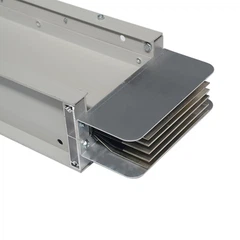
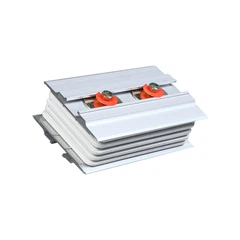
This component adopts an integrated structure combining flexible conductive connections and an enclosed protective housing. High-conductivity flexible copper strips are installed inside as conductive carriers. Both ends are precisely connected to the main busbar trunking via standard flanges, fitted with dedicated insulating supports and sealing structures. While ensuring reliable electrical continuity, it delivers axial expansion compensation capacity. When temperature rises under full-load operation or ambient temperature changes, physical expansion and contraction occur on busbar conductors and housings. Relying on elastic stretching and contraction of its flexible structure, the expansion joint automatically absorbs axial displacement deviations and releases structural stress.
In addition, the expansion joint offsets minor dimensional errors generated during construction and installation, and buffers slight mechanical vibration during equipment operation. Its sealed protective structure retains the original IP protection rating of the busbar trunking, preventing dust and moisture ingress to stabilize insulation performance. Throughout dynamic compensation, conductive contact surfaces remain tightly attached with stable contact resistance and abnormal temperature rise avoided. It guarantees uninterrupted and stable power transmission of the busbar system, and greatly improves long-term operational safety and service life of the equipment.
Application Scenarios
As an essential accessory for high-current busbar systems, the busbar expansion joint serves to compensate displacement caused by thermal expansion and contraction during long-term busbar operation. It is widely applied to industrial and new power distribution scenarios featuring long-distance layout, heavy load and round-the-clock continuous power supply, acting as a critical component to guarantee the safe and stable operation of the entire busbar system.
Firstly, it is suitable for power rooms and industrial park renovation projects with long-distance overhead busbar installation. Long overall busbar layouts suffer continuous expansion and contraction of housings and copper conductors due to seasonal temperature differences and temperature rise under full-load operation. Fitted expansion joints effectively release thermal stress and prevent hidden risks including extruded and deformed busbar housings, loose joints and failed sealing. Secondly, it is extensively adopted in high-load scenarios such as energy storage power stations, data centers and AI computing centers. Busbars in these projects run uninterruptedly at full load all year round with high heat generation and frequent deformation; expansion joints dynamically compensate displacement to maintain long-term stability of power transmission structures.
Moreover, it fits indoor and outdoor mixed working conditions, as well as wiring layouts across walls and floors. It offsets installation deviations resulting from civil construction errors and structural settlement to adapt to complex wiring environments. It is also applicable to high-power engineering projects including new energy factories and photovoltaic DC power distribution. It can effectively reduce equipment failure rates under high-current operation, improve the protection rating, service life and operational safety of the complete busbar system, and meet standardized construction requirements for high-end power distribution projects.
Maintenance & Repair Guidelines
As a dynamic compensation component of the busbar system, the busbar expansion joint operates under repeated deformation from thermal expansion and contraction for a long time. Standardized regular maintenance and inspection are required to secure its expansion compensation performance, sealing protection and electrical stability, extend service life and avoid safety hazards such as loose connections, abnormal temperature rise, water seepage and dust accumulation.
During daily inspections, check the integrity of the expansion joint housing regularly. Verify that the powder coating is intact without peeling, the housing free of deformation and cracks, and the sealing strips complete without aging or hardening to retain the overall dustproof and moistureproof performance. Focus on checking the expansion stroke to ensure no jamming, jacking or stretching restriction, so that displacement caused by thermal expansion and contraction can be compensated freely. Inspect flange bolts at both ends to prevent loose fasteners from long-term vibration, which would lead to poor contact and excessive temperature rise.
For periodic maintenance, remove dust and oil stains on the surface and gaps of the expansion joint to maintain smooth heat dissipation inside the cavity. Inspect flexible conductive strips for twisting, fatigue deformation and black oxidation. Shut down the equipment for overhaul and part replacement immediately if aged seals, stroke jamming or overheated joints are found. Unauthorized disassembly of internal structures or modification of expansion allowance is prohibited, as such operations will damage electrical performance and ingress protection rating. Standard cyclic maintenance ensures the expansion joint delivers stable deformation compensation, supporting long-term safe, low-loss continuous operation of the whole busbar system.
Hot Tags: busduct expansion joint, China busduct expansion joint manufacturers, suppliers, 4000a Bus Duct, Aluminium Bus Duct, Copper Bus Duct, New Generation Compact Busway, sandwich busduct, Sandwich Busway
You Might Also Like


Send Inquiry