



Tee Type Busway
Product Structure Description
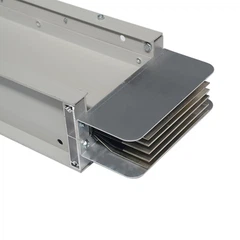
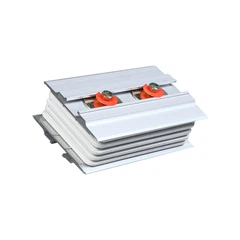
Busbar trunking T-elbow, also known as busbar tee, is the core transition fitting for branch current shunting and power distribution branching in busbar trunking systems. It is divided into two types: vertical T-elbow and horizontal T-elbow, with distinct differences in structural complexity and manufacturing cost.
The vertical T-elbow features a basic shunting structure with an upright T-shaped profile integrally assembled from three sections of busbar housing. Its housing is fabricated by bending and riveting aluminum alloy extrusions, with multi-phase insulated conductors pre-installed inside. Conductors of each branch are interconnected via integrated connection bars. Evenly spaced rivets fasten the side walls of the housing, while sealed connection flanges are fitted at both straight ends and the upper outlet for direct connection to straight busbar sections. Boasting a simple structure without multi-layer internal partition chambers, it requires fewer assembly procedures and carries lower processing costs. It is mainly used for shunting connections between vertical floor risers and horizontal main busbars, ideal for vertical power distribution branching in computer rooms and factories.
The horizontal T-elbow adopts a more complex planar three-branch layout, equipped with additional independent layered insulating partitions and multi-directional shunting conductive connection assemblies inside to balance the phase spacing and insulation clearance of three groups of conductors simultaneously. Its housing is hermetically welded from split modules, with built-in reinforcing support beams to avoid conductor deformation under high-current operating conditions. Each of the three outlets is fitted with an individual sealed flange and dedicated earthing path. More sheet metal bending, conductor jointing and insulation assembly processes are required, leading to higher material waste and labor hours, so its overall production cost exceeds that of the vertical T-elbow.
Both types of tees are equipped with protective sealing gaskets and complete earthing circuits, supporting flexible 3P4W / 3P5W layout. They can steadily carry high currents and satisfy the demand for simultaneous multi-branch power distribution in data centers and energy storage power stations.
Application Scenarios
Busbar trunking tees fall into two shunt fittings: vertical T-type and horizontal T-type. Suitable for various large-current centralized power distribution projects, they serve as indispensable transition components for branch power distribution of main busbars and are widely applied in computing infrastructure, new energy storage stations, industrial plants, commercial complexes and other mainstream scenarios.
In data centers and AI intelligent computing rooms, main busbars are laid horizontally along the length of the building, while numerous cabinet branches require simultaneous power tapping. Horizontal T-tees enable even three-way current shunting on the same plane to support parallel power supply for high-density server cabinet clusters. For vertical power distribution across floors, vertical T-tees are adopted to connect floor main busbars with vertical risers, realizing hierarchical power allocation for upper and lower floors and matching the high-low span power distribution layout of multi-story computer rooms.
New energy projects such as energy storage power stations, centralized photovoltaic plants and ultra-fast charging stations have prominent demands for multi-branch shunting. Multiple independent power supply circuits need to be split from one main busbar for energy storage cabins and charging pile clusters. The two types of tees can be selected according to equipment layout: horizontal tees for densely arranged planar equipment, and vertical tees for layered power distribution of upper and lower energy storage cabins, balancing high current carrying capacity and stable current division performance.
They are also extensively used in large manufacturing workshops, high-rise hotels and commercial complexes. T-tees simplify wiring for branch power supply of multiple production lines in workshops and layered power tapping via vertical distribution shafts in each hotel floor. Compared with traditional cable junction boxes, busbar tees feature lower shunting loss and higher IP protection rating, adapting to harsh environments such as damp basements and outdoor power distribution rooms.
In general, vertical or horizontal T-tees can be deployed as required for any project where two or more independent power distribution branches are tapped from a single main trunk. They deliver efficient trunk line shunting and accommodate all power distribution layouts including vertical elevation differences and planar multi-branch arrangements.
Industry Knowledge
The installation quality of busways directly determines the long-term operational safety of power distribution systems. The complete construction process covers three key phases: pre-installation inspection, installation operation and post-installation acceptance, with standardized testing procedures for each stage.
Before installation, fully inspect the intact condition of all products. Check each busway section for dented/deformed housings, damaged insulation layers and oxidized conductors. Verify that the model and specification of elbows, terminal flanges, plug-in boxes and other accessories match the design drawings. After visual inspection, a megohmmeter must be used to measure the insulation resistance between phases and between each phase and earth. The insulation resistance of low-voltage busways shall not be lower than 20MΩ. If the reading fails to meet the standard, troubleshoot dampness or insulation damage; carry out drying treatment or replace defective busways before construction.
During installation, strictly control assembly details. Arrange hanging brackets evenly per specifications. Clean the surface of overlapping conductors when connecting bus sections and fasten bolts evenly to ensure tight contact without gaps. Install vertical and horizontal T-tees in correct orientation, and reserve proper allowance for thermal expansion and contraction. Embed sealing gaskets completely to guarantee IP protection, and connect housing earthing continuously to form an intact earthing circuit.
After installation, conduct overall re-inspection. Retest the insulation resistance of the entire busway system with a megohmmeter to eliminate short-circuit and leakage risks. Recheck the tightening torque of all connecting bolts, and confirm no stress distortion at tees and elbows. Verify correct phase sequence and attach installation labels. Only after all tests pass can power-on trial operation start. Regularly monitor the temperature rise of joints during initial operation to eliminate hidden dangers of overheating and ensure stable long-term operation of the busway system.
Hot Tags: tee type busway, China tee type busway manufacturers, suppliers, 3 Phase Busbar Trunking, Aluminum Busway, Bus Duct Vertical Elbow, Copper Bus Duct, New Generation Compact Busway, Phase Segregated Bus Duct
You Might Also Like


Send Inquiry