



Busway Flange End
Working Principle
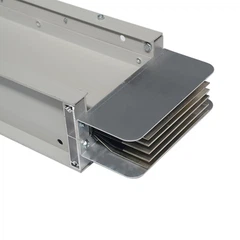
The terminal flange is the core power access component of the busway system, serving as the transitional connection between the bus trunk line and transformers or low-voltage distribution cabinets, and acting as the initial channel for electric power to enter the busway circuit.
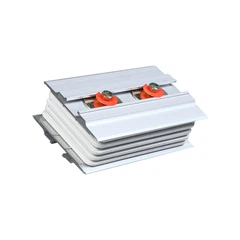
The terminal flange body integrates positioning fixing plates, inter-phase insulation layers, sealing rubber gaskets and multi-phase conductive lugs. One side is tightly connected to the conductors of the first busway section, while the other side is prefabricated with standard bolt holes for external power connection via rigid busbars or flexible copper braided connectors.
Two matching schemes are available for equipment connection. For connection with distribution cabinets, tinned rigid busbars are adopted. One end fastens the conductive lugs of the flange, and the other end is secured to the outgoing copper bars of the main switch inside the cabinet. The rigid conductors deliver stable transmission of heavy current with flat and closely fitted contact surfaces, effectively reducing contact resistance and operating temperature rise. For transformer connection, flexible connectors are preferred. The deformable buffer capacity of flexible conductors offsets displacement stress caused by unit operation vibration and thermal expansion and contraction, preventing cracking of the joints and loose contact between the flange and transformer terminals.
Sealing gaskets fitted on the flange housing provide IP-rated protection to isolate moisture and dust and avoid inter-phase short circuits. The matched metal housing forms a complete earthing circuit to ensure operational safety for maintenance personnel. During operation, current output from transformers or distribution cabinets is transmitted to the multi-phase conductors of the flange through rigid or flexible connectors, then smoothly fed into the internal conductors of the bus trunk to form a continuous and complete power distribution circuit.
The overall structure integrates electrical conduction, mechanical vibration buffering and sealing protection functions. It is applicable to various high-current incoming scenarios such as data centers, energy storage power stations and industrial plants, ensuring long-term stable and low-loss operation of the busway system at the power inlet end.
Selection Guide
As a special fitting for incoming connection of busways, the primary principle for selecting terminal flanges is specification matching. Its busway housing model, phase sequence arrangement, conductor cross-sectional area and protection class must be fully consistent with the main busway body, so as to eliminate potential safety hazards such as contact overheating and sealing failure caused by mismatched dimensions and current-carrying parameters. The conductor material shall also be matched accordingly: aluminum flanges shall be used for aluminum-conductor busways, and copper flanges for copper-conductor busways. This ensures consistent electrical conductivity and reduces overall circuit loss.
Product types shall be selected according to upstream power supply equipment. For connection with low-voltage distribution cabinets, rigid lap-type terminal flanges are recommended. Matched with standard copper bars, they can be directly fastened to the terminals of circuit breakers inside cabinets. The rigid connection structure can stably carry continuous heavy current of several thousand amperes, suitable for fixed power incoming lines in data centers and industrial plants. When connecting to transformers, vibration-damping terminal flanges with flexible connection interfaces are preferred. Pre-installed positions for braided flexible connectors offset displacement induced by equipment vibration and thermal expansion and contraction, preventing terminal loosening and overheating.
Protection configurations shall be determined based on service environments. Standard IP54 flanges are adopted for ordinary dry indoor conditions, while IP68 sealed flanges with thickened waterproof rubber gaskets are selected for outdoor sites, energy storage machine rooms and humid basements. During model selection, verify the rated current and phase structure (3P4W or 3P5W), and match the on-site installation space. Balance electrical reliability, mechanical adaptability and environmental protection requirements to guarantee long-term safe operation of the busway power inlet section.
Certificate of Origin
All complete sets of power distribution products manufactured by our company, including busways, terminal flanges, joint assemblies, plug-in boxes, hanging brackets and other accessories, are entirely produced in Yangzhong City, Zhenjiang City, Jiangsu Province, China. All production, processing and assembly procedures are independently completed in our domestic factory premises, with full and compliant certificate of origin documents available.
Core raw materials of all products, such as conductors, housings, insulating parts and supporting hardware, are sourced from formal domestic manufacturers. There is no processing of semi-finished materials imported from overseas or overseas assembly. The entire production chain of the products is completed within China, complying with China's rules of origin criteria.
For export business, our company can assist in issuing officially recognized certificates of origin, including Certificate of Origin (CO) and Generalized System of Preferences Certificate of Origin FORM A. The information stated on the certificates strictly corresponds to the product model, specification, quantity and HS code of each order, with China clearly marked as the country of origin. These certificates can be used for overseas customs clearance, tariff reduction and qualification verification in project bidding.
All contents of the certificates of origin are authentic and traceable, matching production records, procurement documents and factory inspection reports one-to-one. No false declaration or off-site certificate issuance is involved. Customers may inform us in advance of the certificate purpose and destination country for customs declaration or project bidding. Our company will sort out supporting production documents accordingly to ensure the certificates are compliant and valid, and meet verification requirements of customs authorities, project owners and third-party institutions.
Hot Tags: busway flange end, China busway flange end manufacturers, suppliers, Aluminium Bus Duct, Aluminum Bus Duct, Bus Duct Flange, Bus Duct Flange End, Bus Duct Horizontal Elbow, Bus Duct Vertical Elbow
You Might Also Like


Send Inquiry