


Compact Busway
Working Principle
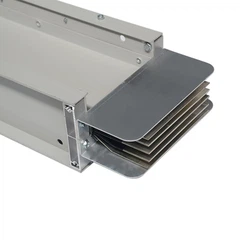
The core working principle of sandwich busduct is based on low-impedance conductors and a compact structural design. It uses copper or aluminum bars as internal conductors, with each phase tightly insulated by dielectric materials and fully enclosed in a metal housing. When current flows through the conductor bars, the large cross‑section and much lower resistance compared to ordinary cables significantly reduce voltage drop and heat generation during high‑current transmission.
The term "sandwich" means there is almost no air gap between conductor bars, with extremely small phase-to-phase spacing. This tight arrangement optimizes the skin effect and proximity effect, leading to more uniform current distribution, while reducing line inductive reactance and improving the power factor. The metal housing not only provides mechanical protection but also serves as an integrated grounding path to ensure safe dissipation of fault currents.
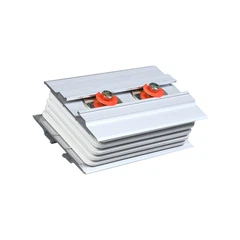
During installation, multiple busbar sections are connected electrically and mechanically via special connectors. The joints adopt a double-sided lap structure with very low contact resistance. The system is fed from transformers or main distribution panels, runs along the routing to supply power, and can branch out circuits through plug-in boxes. Since conductor heat is directly conducted to the housing for dissipation, heat dissipation efficiency is high. As a result, the current-carrying capacity of busbars is several times higher than that of cables with the same cross‑section.
In summary, sandwich busbar trunking achieves safe, compact, and high-capacity power transmission through low impedance, tight coupling, and high-efficiency heat dissipation.
Processing Flow
1.Conductor Processing
High-conductivity copper or aluminum bars are selected, sheared, punched, and bent to shape. Lap surfaces are fabricated per drawing requirements, followed by deburring and polishing to minimize contact resistance.
2.Insulation Coating
Using automatic wrapping equipment, polyester film insulation is uniformly wound in multiple layers around conductors to ensure phase-to-phase and phase-to-ground insulation strength.
3.Housing Fabrication
Galvanized steel or aluminum alloy sheets are cut, stamped, bent, and welded to form a high-strength enclosed casing. The housing surface receives electrostatic powder coating or passivation for improved corrosion resistance.
4.Assembly
Insulated conductors are arranged tightly phase by phase with zero gaps, then installed into the housing. Insulation parti
tions position conductors relative to each other and the housing to maintain a compact structure.
5.Inspection and Testing
Each section undergoes insulation resistance, power-frequency withstand voltage, DC resistance, and grounding continuity testing. Passed units are packed and stored.
Quality Assurance
Our products are equipped with CQC certification and CE certification.
The CQC mark certification is a voluntary product certification service provided by the China Quality Certification Center (CQC). The CQC mark indicates that the product complies with requirements for quality, safety, performance, and electromagnetic compatibility (EMC).Busbar trunking CQC certification is conducted in accordance with the standard GB/T 7251.6-2015, covering key test items including insulation resistance, dielectric strength, temperature rise, short-time withstand current, and degree of protection. This ensures product safety and reliability in the Chinese domestic market. CQC certification enhances product competitiveness and serves as a strong qualification for bidding in major domestic engineering projects.
The CE mark is a mandatory conformity assessment mark for the European Union market, certifying that the product meets the essential safety and health requirements stipulated by EU regulations.Busbar trunking exported to the EU must be certified in accordance with EN 61439-6 (equivalent to IEC 61439-6), applied in conjunction with the Low Voltage Directive (LVD) 2014/35/EU. Certification covers verification of temperature rise limits, short-time withstand strength, dielectric properties, and degree of protection.Manufacturers must complete type tests in laboratories accredited by a Notified Body, sign a Declaration of Conformity, and affix the CE mark before the product can be freely circulated in the European market.
Hot Tags: compact busway, China compact busway manufacturers, suppliers, Busway Tap off Unit, Busway Vertical Elbow, Bus Duct Flange, New Generation Compact Busway, Compact Busduct, 3 Phase Busbar Trunking
You Might Also Like


Send Inquiry