


Flameproof Bus Duct
Core Component Description
The core fire-resistant component of fire-resistant busduct is the ceramic fiber blanket (also known as fire-resistant cotton) filled inside. Manufactured from high-purity alumina, silica and other inorganic fibers via a special process, this fire-resistant blanket is classified as Class A non-combustible material. It features an extremely low thermal conductivity, together with excellent high-temperature resistance and thermal shock resistance.
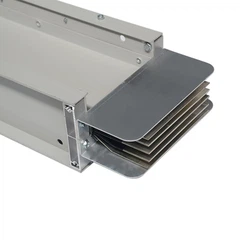
In the structural design of the busduct, the ceramic fiber blanket is tightly wrapped around the conductors and insulation layers. Together with the metal protective enclosure, it forms a robust fire and heat insulation barrier. In extreme high-temperature conditions such as fire, the ceramic fiber blanket effectively blocks external heat from transferring inward. It prevents the internal insulation materials from carbonizing and failing under high heat, which would otherwise cause short circuits. As a result, the busduct can maintain circuit integrity for the specified duration even under intense flame temperatures above 950°C.
Meanwhile, the material boasts outstanding chemical stability. It is non-ageing, corrosion-resistant, lightweight and flexible, capable of absorbing vibration stress generated during operation. The adoption of this core component greatly raises the overall fire resistance rating of the busduct. It provides a safe and reliable power lifeline for critical equipment inside buildings, including fire pumps, smoke exhaust fans and emergency lighting systems.
Reliability Data Presentation
Our NHMC series fire-resistant busducts have passed rigorous type tests conducted by authoritative institutions, demonstrating outstanding electrical reliability and adaptability to extreme operating conditions. This product series covers rated currents from 400A to 4000A and a rated insulation voltage of 1000V. It delivers an ultimate short-circuit withstand capacity of 80 kA short-time withstand current and 176 kA peak withstand current. All dielectric parameters and protective circuit continuity remain intact upon completion of short-circuit tests.
In extreme fire simulation tests, supported by a composite heat-insulating structure consisting of "ceramifiable fire-resistant composite tape + aluminum silicate fireproof wool + three-layer steel enclosure", the product shows no fusing or breakdown when exposed to sustained combustion at temperatures above 950°C for 180 minutes, successfully maintaining circuit integrity.
Furthermore, the product achieves an IP66 protection rating and has passed weather resistance tests including salt spray, damp heat and mechanical load tests. In the full-load 4000A temperature-rise test, the maximum temperature rise at internal busbar joints is only approximately 63 K, while the enclosure temperature rise is controlled within 42 K, well below the national standard limits of 70 K and 55 K respectively. Combined with passed 12 kV impulse voltage withstand and 2200 V power-frequency voltage withstand tests, it ensures insulation will not fail due to thermal stress under full-load operation.
The product also complies with Class A EMC requirements. Comprehensive test data fully verifies its long-term safety and stability for critical power distribution scenarios such as fire protection systems and data centers.
Frequently Asked Questions
1. What is the generally required fire resistance duration?
A: In accordance with Chinese national standards (e.g., XF/T 537), fire-resistant busducts for fire-fighting equipment are generally required to achieve a fire resistance duration of 180 minutes (3 hours), so as to allow sufficient time for rescue and evacuation.
2. What are the main application scenarios for fire-resistant busducts?
A: They are mainly deployed in locations with stringent requirements for continuous fire-fighting power supply, such as fire pump rooms, smoke exhaust fans, emergency lighting systems, refuge floors of high-rise buildings, and critical facilities including hospitals, metro stations and data centers.
3. What special designs are adopted for its enclosure and internal structure?
A: Multi-layer steel enclosures with fire-retardant coating are commonly used. Internal conductors are wrapped with fire-resistant insulating tapes, and thick fireproof wool is filled between layers to form a composite protective structure of multi-stage "enclosure + heat insulation layer".
4. Are there any environmental requirements for the installation of fire-resistant busducts?
A: Despite its fire-resistant performance, installation shall avoid areas with permanent water accumulation or extreme humidity as far as possible. Joints must be properly sealed to maintain the protection rating and prevent moisture ingress that may impair insulation performance.
5. Can fire-resistant busducts be mixed with ordinary sandwich busducts?
A: Mixing is not permitted. Fire-resistant busducts must be used for the entire fire power supply circuit. If connected in tandem with ordinary busducts, the ordinary section will fail first in a fire, paralyzing the whole fire-fighting power supply system.
6. What routine maintenance is required?
A: Regularly inspect the enclosure for corrosion and check whether connecting bolts are loose. Insulation resistance shall be tested annually with a megohmmeter. Keep the surface clean to avoid dust or moisture impairing heat dissipation and insulation.
Hot Tags: flameproof bus duct, China flameproof bus duct manufacturers, suppliers, 3 Phase Fire Resistant Busway, electrical distribution system, Fire Resistant Busduct Elbow, fire resistant busway, Fire Resistant Busway Feeder Unit, Fireproof Bus Duct
You Might Also Like


Send Inquiry