


Underground Epoxy Busway
Product Structure Overview
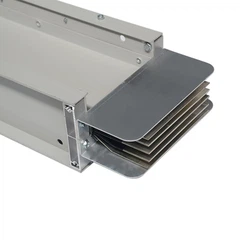
Cast busduct features a monolithic, fully enclosed solid casting structure. It has an outer shell of insulating resin (generally epoxy resin or polymer composite material with customizable colours) that fully encapsulates the internal conductive core. As can be clearly seen from the end cross-section, multiple rectangular copper bars are used as main conductors. The copper bars of each phase are arranged closely and in parallel complying with design specifications, with flush ends to facilitate subsequent joint connection and insulation treatment. There are no air gaps between conductors and insulating resin, forming a highly dense integrated insulation body through the casting process.
This structural design not only delivers high mechanical strength and impact resistance to effectively resist external physical damage, but also completely prevents the ingress of moisture, dust and corrosive gases. Meanwhile, the fully cast structure achieves excellent electrical insulation and flame-retardant properties, making it ideal for harsh environments such as humid and dusty conditions, as well as complex power distribution scenarios with limited space.
Project Case Studies

As shown in the figure, this project involves the installation of cast busduct laid in an outdoor cable trench. Located in a humid underground environment, the trench is prone to water and silt accumulation, and subject to the intrusion of moisture, dust and corrosive media, which sets stringent requirements on the protection class and insulation stability of the power distribution busbar.
The project adopts fully resin-cast busduct. Featuring a monolithic epoxy resin casting and sealing structure with no air gap between conductors and the enclosure, it can effectively resist ingress of moisture, mud and water, and delivers outstanding waterproof, dustproof and anti-corrosion performance, making it suitable for long-term high-humidity operating conditions such as cable trenches. The busduct is fixed and installed at designed spacing inside the trench. Brackets are treated for anti-corrosion, proper allowance for thermal expansion and contraction is reserved, and end sealing and phase sequence marking are properly implemented to mitigate risks of insulation degradation, electric leakage and short circuits caused by underground conditions.
Compared with conventional power cables and compact busducts, cast busduct requires no additional complicated waterproof covers. It boasts a robust structure, strong mechanical impact resistance and low maintenance workload in later stages. This solution reliably carries large current and ensures continuous and stable power supply for the plant's power distribution circuits. It demonstrates the prominent suitability of cast busduct for humid underground scenarios including cable trenches and utility tunnels, and provides a proven and feasible reference for material selection of similar underground power distribution projects.
Maintenance Guide
Cast busduct adopts a fully enclosed resin monolithic casting structure, featuring superior insulation performance as well as excellent waterproof, dustproof and corrosion resistance. It is virtually maintenance-free under normal operating conditions. Nevertheless, regular standardized inspection and maintenance are still recommended to guarantee the long-term safety and stability of the power distribution system.
During maintenance, first inspect the resin casting body on the busduct enclosure and joints for cracks, damage, blistering or discoloration. Verify that connecting bolts are properly tightened, and check for signs of abnormal discharge or overheating caused by loose fasteners. Secondly, check that brackets and hangers are securely fixed to prevent the busduct from external compression or unsupported loading.
In addition, an insulation resistance test with a megohmmeter is recommended once a year, and an infrared thermometer shall be used to monitor temperature rise at joints and plug-in points. Long-term overload operation of the busduct is strictly prohibited. If insulation degradation or abnormal local temperature rise is detected, power supply shall be cut off immediately for troubleshooting, and professional technicians shall be contacted for repair to eliminate potential hazards.
Hot Tags: underground epoxy busway, China underground epoxy busway manufacturers, suppliers, Cast Resin Busway, Modular Plug in Cast Resin Busduct, New Generation Cast Resin Busway, Outdoor Bus Duct, Outdoor Busway, Waterproof Busbar
You Might Also Like


Send Inquiry