

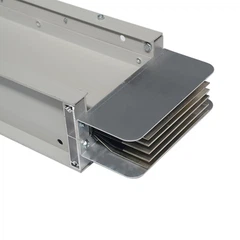
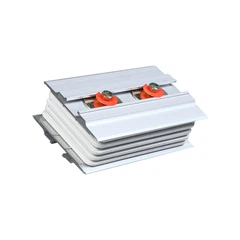
How does heat - dissipation affect the performance of Aluminum Bus Duct?
Sep 24, 2025
Leave a message
Heat dissipation is a critical factor that significantly influences the performance of Aluminum Bus Duct. As a supplier of Aluminum Bus Duct, I have witnessed firsthand how efficient heat management can enhance the functionality and longevity of these essential electrical components. In this blog, we will delve into the intricate relationship between heat dissipation and the performance of Aluminum Bus Duct, exploring the underlying mechanisms, challenges, and solutions.


The Basics of Heat Generation in Aluminum Bus Duct
Aluminum Bus Ducts are widely used in electrical distribution systems to transmit electrical power from a source to various loads. During operation, electrical current flowing through the bus duct generates heat due to the resistance of the aluminum conductors. According to Joule's law, the heat generated (H) is proportional to the square of the current (I), the resistance (R) of the conductor, and the time (t) for which the current flows, expressed as H = I²Rt.
In a typical Aluminum Bus Duct, the heat generated is a result of both the DC resistance of the conductors and the AC losses, which include skin effect and proximity effect. The skin effect causes the current to concentrate near the surface of the conductor at high frequencies, increasing the effective resistance and thus generating more heat. The proximity effect occurs when multiple conductors are placed close to each other, causing the current distribution to be non - uniform and further increasing the resistance and heat generation.
Impact of Heat on Aluminum Bus Duct Performance
Electrical Conductivity
One of the primary ways heat affects Aluminum Bus Duct performance is by altering the electrical conductivity of the aluminum conductors. As the temperature of the aluminum increases, the atomic vibrations within the metal lattice become more intense. This increased atomic motion impedes the flow of electrons, leading to an increase in electrical resistance. A higher resistance means more power is dissipated as heat, creating a positive feedback loop that can cause the temperature to rise even further.
For example, if the temperature of an Aluminum Bus Duct rises from 20°C to 80°C, the electrical resistance of the aluminum conductors can increase by approximately 20 - 30%. This increase in resistance not only reduces the efficiency of power transmission but also leads to higher energy losses in the form of heat.
Mechanical Integrity
Heat can also have a detrimental impact on the mechanical integrity of Aluminum Bus Duct. Aluminum has a relatively high coefficient of thermal expansion. When the temperature of the bus duct changes, the aluminum conductors expand or contract. If the heat dissipation is inadequate and the temperature fluctuates significantly, the repeated expansion and contraction can cause mechanical stress on the bus duct components, such as joints and supports.
Over time, these stresses can lead to loosening of connections, which can further increase the resistance at the joints and generate more heat. In extreme cases, the mechanical stress can cause cracks or fractures in the bus duct, compromising its structural integrity and posing a safety hazard.
Insulation Performance
The insulation materials used in Aluminum Bus Duct are also sensitive to temperature. Most insulation materials have a maximum operating temperature rating. If the temperature of the bus duct exceeds this rating due to poor heat dissipation, the insulation can degrade over time.
When the insulation degrades, its dielectric strength decreases, increasing the risk of electrical breakdown and short - circuits. This can lead to power outages, equipment damage, and even pose a fire hazard. For instance, some common insulation materials like PVC can start to soften and lose their insulating properties at temperatures above 70 - 80°C.
Factors Affecting Heat Dissipation in Aluminum Bus Duct
Conductor Design
The design of the aluminum conductors plays a crucial role in heat dissipation. The cross - sectional area of the conductors affects the current - carrying capacity and the resistance. A larger cross - sectional area allows for a lower current density, which reduces the heat generated per unit volume of the conductor.
Additionally, the shape of the conductors can influence heat dissipation. For example, flat conductors have a larger surface area compared to round conductors of the same cross - sectional area. A larger surface area allows for more efficient heat transfer to the surrounding environment through convection and radiation.
Ventilation and Airflow
Proper ventilation and airflow are essential for effective heat dissipation in Aluminum Bus Duct. Natural convection occurs when the warm air around the bus duct rises, creating a flow of cooler air to replace it. However, in enclosed spaces or installations with limited airflow, natural convection may not be sufficient to remove the heat generated.
In such cases, forced ventilation systems can be used to enhance heat dissipation. Fans or blowers can be installed to increase the airflow around the bus duct, carrying away the heat more effectively. The direction and speed of the airflow also need to be carefully designed to ensure uniform cooling of the bus duct components.
Enclosure Design
The enclosure of the Aluminum Bus Duct can either facilitate or impede heat dissipation. A well - designed enclosure should have adequate ventilation openings to allow for the exchange of air. The material of the enclosure also matters. Aluminum enclosures are often preferred because aluminum is a good conductor of heat, which helps in transferring the heat from the conductors to the outside environment.
However, if the enclosure is too small or has a poor design, it can trap the heat inside, leading to higher temperatures within the bus duct. For example, an enclosure with blocked ventilation holes can significantly reduce the heat dissipation rate.
Strategies for Improving Heat Dissipation
Optimized Conductor Selection
As a supplier, we offer a range of Aluminum Bus Ducts with different conductor designs to meet various heat dissipation requirements. By carefully selecting the cross - sectional area and shape of the conductors based on the expected current load and operating conditions, we can minimize heat generation and improve heat dissipation.
For example, for high - current applications, we may recommend using bus ducts with larger cross - sectional conductors or multiple parallel conductors. This reduces the current density and spreads the heat over a larger area.
Enhanced Ventilation Systems
We also provide solutions for improving ventilation in Aluminum Bus Duct installations. Our technical team can design custom - made ventilation systems, including fans and ducting, to ensure adequate airflow around the bus duct. These systems can be tailored to the specific requirements of the installation, taking into account factors such as the size of the bus duct, the available space, and the ambient temperature.
Advanced Enclosure Designs
Our Aluminum Bus Duct enclosures are designed with heat dissipation in mind. We use high - quality aluminum materials with good thermal conductivity and incorporate ventilation features such as louvers and vents. The enclosures are also designed to allow for easy access for maintenance and inspection, which helps in ensuring that the ventilation openings remain unblocked.
Conclusion
Heat dissipation is a vital aspect of Aluminum Bus Duct performance. Inadequate heat dissipation can lead to a range of problems, including reduced electrical conductivity, mechanical damage, and insulation degradation. As a [Your Company's Position] in the field of [Aluminum Bus Duct], we understand the importance of effective heat management and offer comprehensive solutions to address these challenges.
If you are in need of high - quality [Aluminum Bus Duct] with excellent heat dissipation capabilities, please do not hesitate to contact us for procurement and further discussions. We are committed to providing you with the best products and services to meet your electrical distribution needs.
References
- Grover, F. W. (1946). Inductance Calculations: Working Formulas and Tables. Dover Publications.
- Dorf, R. C., & Svoboda, J. A. (2015). Introduction to Electric Circuits. Wiley.
- Neher, J. H., & McGrath, M. H. (1957). A Method of Calculating the Temperature Rise and Load Capability of Cable Systems. AIEE Transactions, 76(3), 752 - 772.
Send Inquiry