

Busways For AI Computing Power
Nov 19, 2026
Leave a message
Since the start of 2026, driven by the continuous rise in AI power density and accelerated construction of intelligent computing centers, new product launches in the busway industry have shown a distinct dual focus: computing-power adaptation and high-voltage direct current (HVDC).
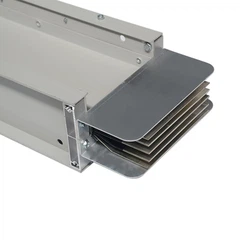
Among the newly released products unveiled recently, ABB's WavePro‑II Edge DC busbar system, developed for 800 V DC power distribution architectures, has attracted particular attention. Rated for 1000 VDC, it adopts a fully symmetrical mirror layout, with positive and negative copper conductors arranged symmetrically on either side of a centrally placed PE conductor. Addressing the physical characteristic that DC arcs lack a natural current zero point and cannot self-extinguish easily, it is fitted with quick-trip DC circuit breakers in tap-off units to isolate faults locally. The product offers optional IP42 to IP66 ingress protection ratings and 180-minute fire resistance for installation within building structures. It was officially launched at the China International Import Expo.
Eaton has introduced an epoxy fluidized-bed insulated bus duct. Using an epoxy fluidized-bed coating process, the insulation layer is integrally bonded to the conductor. Its heat dissipation performance is improved by 20%, and it can withstand direct exposure to 1300 °C flame for 10 seconds, with an IP66 protection rating. It is designed primarily to resolve the conflict between insulation and heat dissipation in high-humidity and corrosive environments such as outdoor sites and coastal areas.
Meanwhile, Witong Electric has identified AIDC as a core growth downstream market for its busway products. It rolled out the new Pro VU busway in the first half of the year and delivered multiple high-current DC bus duct projects. Ruineng Electric launched an AC 1250 A full-position sliding-rail smart busway. Its profiled copper bars expand the heat dissipation area threefold compared with conventional copper conductors. It supports live expansion without power shutdown and cuts installation costs by 50% versus traditional solutions.
The wave of these new releases signals that technological competition for busways is no longer limited to simple comparisons of current-carrying capacity or ingress protection. Instead, it has shifted toward systematic upgrades centered on DC distribution safety, power density per unit space, and full-lifecycle deployment efficiency. Busways are rapidly evolving from mere "electric conduction channels" into a power distribution foundation for computing infrastructure.
Send Inquiry