

How to calculate the short - circuit current of air - insulated bus duct?
Oct 07, 2025
Leave a message
Hey there! As an air-insulated bus duct supplier, I often get asked about how to calculate the short-circuit current of air-insulated bus duct. It's a crucial topic because understanding short-circuit current is essential for ensuring the safety and reliability of electrical systems. In this blog post, I'll walk you through the process step by step.
First off, let's understand what short-circuit current is. A short circuit occurs when there's an unintended low-resistance connection between two points in an electrical circuit. This causes a large amount of current to flow, which can damage equipment and pose a serious safety hazard. The short-circuit current is the current that flows during this short-circuit event.
Why Calculate Short-Circuit Current for Air-Insulated Bus Duct?
Air-insulated bus ducts are widely used in electrical distribution systems to transmit electrical power. They need to be able to withstand short-circuit currents without failing. By calculating the short-circuit current, we can select the right size and rating of the air-insulated bus duct. This ensures that it can handle the fault current without overheating, deforming, or causing other problems.
Step 1: Gather System Information
The first thing you need to do is gather some information about the electrical system. This includes:
- Source Voltage: You need to know the voltage of the power source that supplies the bus duct. For example, in many industrial and commercial applications, the source voltage might be 480V or 600V.
- Transformer Rating: If there's a transformer in the system, you need to know its rating in kilovolt-amperes (kVA) and its impedance percentage. The transformer impedance affects the short-circuit current that can flow in the system.
- Cable Length and Size: The length and size of the cables connected to the bus duct also play a role. Longer cables and smaller cable sizes have higher resistance, which can limit the short-circuit current.
Step 2: Calculate the Equivalent Impedance
Once you have the system information, you can calculate the equivalent impedance of the system. The impedance is a measure of the opposition to the flow of alternating current. It includes both resistance and reactance.
- Transformer Impedance: You can calculate the transformer impedance using its rated kVA and impedance percentage. The formula for calculating the transformer impedance in ohms is:
[Z_{T}=\frac{V^{2}}{S_{T}}\times\frac{Z_{T}%}{100}]
where (Z_{T}) is the transformer impedance in ohms, (V) is the rated voltage in volts, (S_{T}) is the transformer rating in volt-amperes, and (Z_{T}%) is the transformer impedance percentage.
-
Cable Impedance: The cable impedance can be calculated using the cable's resistance and reactance per unit length. You can find these values in cable manufacturer's catalogs. The total cable impedance is the product of the impedance per unit length and the cable length.
-
Bus Duct Impedance: The impedance of the air-insulated bus duct can also be obtained from the manufacturer's data. It depends on the bus duct's size, configuration, and material.
The equivalent impedance of the system is the sum of the transformer impedance, cable impedance, and bus duct impedance.
Step 3: Calculate the Short-Circuit Current
Once you have the equivalent impedance, you can calculate the short-circuit current using Ohm's Law. Ohm's Law states that (I = \frac{V}{Z}), where (I) is the current, (V) is the voltage, and (Z) is the impedance.
The short-circuit current at the bus duct can be calculated as:
[I_{sc}=\frac{V}{\sqrt{3}\times Z_{eq}}]
where (I_{sc}) is the short-circuit current in amperes, (V) is the source voltage in volts, and (Z_{eq}) is the equivalent impedance of the system in ohms. The (\sqrt{3}) factor is used because we're dealing with a three-phase system.


Step 4: Consider Other Factors
There are some other factors that you need to consider when calculating the short-circuit current:
- Asymmetry: In a real-world electrical system, the short-circuit current is not always symmetric. There can be an asymmetry due to the presence of inductance and capacitance in the system. To account for this, you might need to calculate the maximum and minimum short-circuit currents.
- Motor Contribution: If there are large motors in the system, they can contribute to the short-circuit current. Motors can act as generators during a short-circuit event and supply additional current to the fault. You need to consider the motor rating and its characteristics when calculating the short-circuit current.
Step 5: Select the Right Air-Insulated Bus Duct
After calculating the short-circuit current, you can select the right air-insulated bus duct. You need to choose a bus duct with a short-circuit withstand rating that is higher than the calculated short-circuit current. This ensures that the bus duct can handle the fault current without failing.
Using Our Products
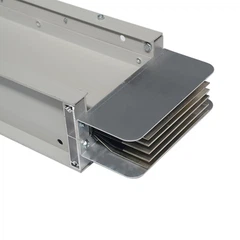
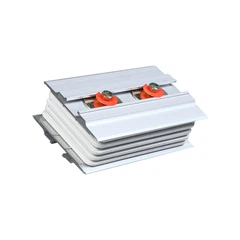
At our company, we offer a wide range of Air Insulated Busbar products. Our air-insulated bus ducts are designed to meet the highest standards of quality and safety. We also provide detailed technical support to help you calculate the short-circuit current and select the right product for your application.
If you need Air-Insulated Bus Duct Elbow or Lighting Bus Duct, we've got you covered. Our elbow and lighting bus duct products are designed to fit seamlessly into your electrical system.
Conclusion
Calculating the short-circuit current of air-insulated bus duct is an important step in ensuring the safety and reliability of your electrical system. By following the steps outlined in this blog post, you can calculate the short-circuit current and select the right air-insulated bus duct for your application.
If you have any questions or need help with your air-insulated bus duct selection, don't hesitate to get in touch. We're here to help you make the right choice and ensure that your electrical system runs smoothly.
References
- Electrical Power Systems Quality, by Roger C. Dugan, Mark F. McGranaghan, and Surya Santoso.
- IEEE Standard 141-1993 (Redline), Recommended Practice for Electric Power Distribution for Industrial Plants.
Send Inquiry