

Application Scenario Analysis
1. Fire Protection Systems in High-Rise Buildings
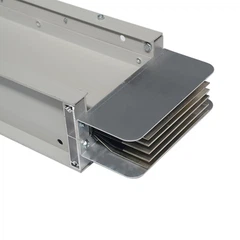
In super high-rise buildings, fire-resistant busways serve as the "lifeline" for critical equipment such as fire pumps, smoke exhaust fans, and emergency lighting. With aluminum alloy casings and built-in fireproof cotton, they can continuously supply power to fire protection systems during fires.
2. Disaster Recovery Systems in Data Centers
In data centers, fire-resistant busways must be installed in disaster recovery rooms and UPS power distribution loops to address emergencies like fires. Compared with ordinary dense-type busways, fire-resistant busways can maintain power supply during fires while having similar impedance values to conventional dense-type busways, thus avoiding increased power loss in daily operations. They leverage fire-resistant advantages only in fire scenarios, achieving the dual objectives of "high efficiency in normal operation + reliable backup in disasters".
3. Underground Transportation Hubs
In enclosed scenarios such as subway stations and underground tunnels, the demand for fire-resistant power supply is extremely urgent. Fire-resistant busways are mainly applied in subway projects for power supply to tunnel section lighting, ventilation equipment, and station fire protection equipment.
4. Commercial and Public Buildings
Fire Protection Zones in Shopping Malls:Fire-resistant busways are used to connect fire compartments in commercial complexes. Fireproof partitions are installed at the joints to prevent cross-regional fire spread, while supplying power to fire elevators, emergency broadcasting systems and other equipment.
ICU Areas in Hospital:Triple-A hospitals adopt dual-loop fire-resistant busways for intensive care units: one loop connects to the municipal power supply, and the other to diesel generators. When the main power fails due to fire, the backup power is automatically activated via busways to ensure continuous operation of ventilators, ECG monitors and other life-support equipment.
Our Construction Case Studies


Notes for Attention
The main drawbacks of fire-resistant busways are their higher cost and greater weight due to the added fire-resistant layer, so they should be used with caution in non-fire protection load scenarios. In addition, during installation, mixing with ordinary busways should be avoided, and the fire-resistant treatment of joints must strictly follow specifications; otherwise, the overall fire-resistant performance may be affected.