

What are the installation clearances for sandwich busduct?
Nov 11, 2025
Leave a message
Hey there! I'm a supplier of sandwich busduct, and today I wanna chat about something super important: the installation clearances for sandwich busduct.
First off, let's get into why installation clearances matter. When you're dealing with sandwich busduct, proper clearances are crucial for safety and performance. They help prevent short - circuits, reduce the risk of overheating, and ensure that the busduct operates efficiently over its lifespan.
Clearances for Air and Space
One of the key aspects of installation clearances is the air and space around the busduct. You need to have enough air circulation to dissipate heat. In general, a minimum of 100mm (about 4 inches) of clearance on all sides of the busduct is a good starting point. This allows for proper ventilation, which is essential since the busduct generates heat during operation.
If you install the busduct too close to walls or other equipment, the heat can build up, leading to increased resistance in the conductors. Higher resistance means more energy is wasted as heat, and it can also cause premature wear and tear on the busduct components.
Clearances from Other Electrical Equipment
Another important consideration is the clearance from other electrical equipment. When installing sandwich busduct near transformers, switchgear, or other high - voltage devices, you need to follow specific guidelines. For example, when placed near a transformer, a clearance of at least 300mm (about 12 inches) is often recommended.
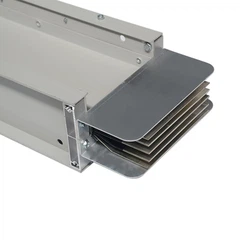
This separation helps prevent interference between the different electrical components. Electrical fields can interact, and if the busduct is too close to other equipment, it could lead to malfunctions or even safety hazards. The Bus Duct Flange plays a role here, as proper installation of the flange helps maintain the integrity of the busduct and its connection to other equipment, which in turn affects the required clearances.
Vertical and Horizontal Clearances
When it comes to vertical and horizontal installations, there are different clearance requirements. For vertical installations, you need to ensure that there is enough space between each section of the busduct. A vertical clearance of at least 150mm (about 6 inches) between sections is typically advisable. This allows for easy inspection and maintenance, as well as providing room for any expansion or contraction that might occur due to temperature changes.
In horizontal installations, the clearances are also important. You should maintain a minimum horizontal clearance of 200mm (about 8 inches) between the busduct and any nearby structural elements or other equipment. This ensures that there is enough space for workers to access the busduct for installation, repair, or replacement.
Clearances for Different Voltage Levels
The voltage level of the sandwich busduct also affects the installation clearances. For Low Voltage Bus Duct, the clearances can be relatively smaller compared to high - voltage busducts. Low - voltage busducts usually require a minimum clearance of around 75mm (about 3 inches) from non - conductive surfaces and 150mm (about 6 inches) from conductive surfaces.
On the other hand, high - voltage busducts demand much larger clearances. For example, a high - voltage busduct operating at 10kV might need a clearance of at least 500mm (about 20 inches) from other equipment and structures. This is because high - voltage systems have a greater potential for arcing and electrical breakdown, and larger clearances help mitigate these risks.
Impact of Environmental Conditions
Environmental conditions also play a role in determining the installation clearances. In a dusty or dirty environment, you might need to increase the clearances to prevent the accumulation of dust on the busduct. Dust can act as an insulator, which can lead to overheating if it builds up on the conductors.
In a humid environment, proper clearances are necessary to prevent moisture from causing corrosion or short - circuits. You may need to provide additional ventilation or use moisture - resistant coatings on the busduct to ensure its long - term performance.
Installation Clearances and 3 Phase Busbar Trunking
For 3 - phase busbar trunking, the installation clearances are similar to those of regular sandwich busduct, but there are some additional considerations. Since 3 - phase systems carry multiple currents, the magnetic fields generated can interact with nearby objects. This means that you need to be extra careful with the clearances to avoid any interference with other electrical or electronic devices.
The phase conductors in a 3 - phase busbar trunking should also have proper separation within the busduct itself. A minimum separation of 25mm (about 1 inch) between phase conductors is often recommended to prevent short - circuits and reduce the risk of electrical arcing.
Importance of Following Standards
It's super important to follow the relevant industry standards when determining the installation clearances for sandwich busduct. Standards such as IEC (International Electrotechnical Commission) and NEC (National Electrical Code) provide detailed guidelines on clearances, based on years of research and experience.
Not following these standards can not only lead to safety issues but can also void the warranty of the busduct. So, make sure you or your installation team are well - versed in the applicable standards before starting the installation process.
Conclusion and Call to Action
In conclusion, installation clearances for sandwich busduct are a critical aspect of ensuring the safety, performance, and longevity of the system. Whether it's the air and space around the busduct, the clearance from other electrical equipment, or the impact of environmental conditions, every factor needs to be carefully considered.
If you're in the market for sandwich busduct or need more information about installation clearances, I'm here to help. I've got a wide range of high - quality sandwich busduct products that meet all the industry standards. Reach out to me for more details and let's start a conversation about your specific requirements. Whether you're working on a small - scale project or a large industrial installation, I can provide the right solutions for you.


References
- International Electrotechnical Commission (IEC) standards
- National Electrical Code (NEC)
Send Inquiry